
Case study: building a register for an independent investment bank
An independent investment bank replaced a distributed process with a living register mapped to its policies and owners — and walked into its next exam with the evidence already assembled.
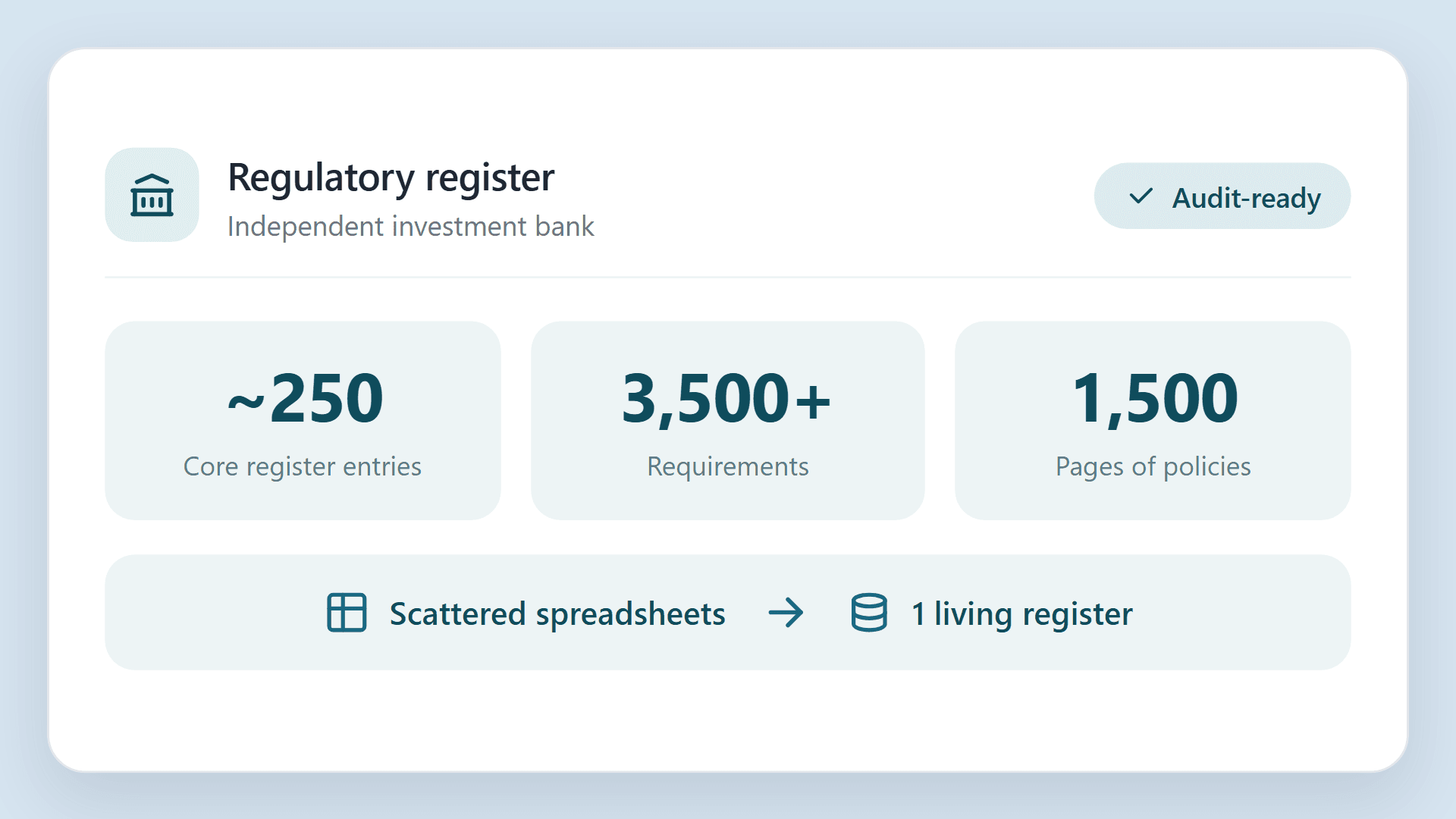
An independent investment bank came to Responsiv with a familiar problem: it had no documented register, the references that did exist in its policies hadn't been reviewed in years, and the leader who held most of the knowledge was about to leave. No one could say with confidence that the firm's policies covered everything the rules required. Here's how the team built a living register — and captured that knowledge before it walked out the door.
The challenge
With roughly 1,000 employees across the US, UK, Ireland, and the EU, the firm operated under a stack of overlapping regimes — SEC and FINRA in the US, the FCA in the UK, the Central Bank of Ireland, and EU rules such as MiFID II. It had grown into that footprint faster than its compliance infrastructure could keep up, and there was no documented register tying those obligations to the policies meant to satisfy them. The result was predictable:
- Some policies cited the relevant laws, rules, and regulations, but there was no defined standard for how to do this — and no single view of which rules applied and which policies addressed them.
- The references that did exist had gone stale. No one had reviewed them in a couple of years, so no one could say with confidence they were still accurate.
- Key-person risk. A senior leader who held much of the firm's institutional knowledge on this topic was leaving — and that understanding lived in their head, not in a system.
What they needed
The Head of Compliance framed the goal simply: a register that could answer "which rule requires this, and what do we do about it?" for any obligation — one that captured the departing leader's knowledge in a durable system before it walked out the door, and that wouldn't rot the moment the project ended.
The approach
The team built the register in stages, using Responsiv at each step:
- Scoped the regulatory universe. They defined the jurisdictions, regulators, and topics that applied — the SEC and FINRA in the US, the FCA in the UK, the Central Bank of Ireland, and the EU regimes touching their business — to set the boundary of the register.
- Ran their policies through Policy Scanner. Each existing policy was scanned to surface the rules driving it and, just as usefully, the obligations that weren't covered anywhere.
- Built the register from the obligations. The discrete obligations became the rows of the register, each mapped to a policy and control and anchored to the live source rule.
- Shared requirements and gaps with the business. Each policy owner received a clear output of the requirements that applied to them and the gaps where a policy fell short — so the people closest to the work could validate the mapping and close what was missing.
The results
Within weeks the firm had a register that did what the spreadsheets never could:
- A single, current view of every applicable obligation mapped to the policy that addressed it.
- Coverage gaps surfaced and closed before the exam rather than during it.
- Rule changes flowing automatically to the owners responsible, instead of waiting for someone to notice.
- The departing leader's knowledge captured in the register before they left — turning years of undocumented expertise into something the team could see, question, and maintain.
“The whole exercise was genuinely eye-opening. There were obligations I would have sworn we already had covered in our policies — and it turned out we simply didn't.”
Where they are now
The register has become the backbone of the firm's compliance program. New policies are scanned and added as they're written, and the horizon scanner watches the regulators in scope — the SEC, FINRA, the FCA, the Central Bank of Ireland, and the EU regimes touching the business — so when one of those bodies changes a rule the affected obligations and their owners are flagged automatically. Keeping the register current is no longer a manual chore; obligations stay mapped to the rules as they move, and exam readiness is a standing state rather than a quarterly project. The spreadsheets are retired.