
How to build an LRR register in Responsiv (and keep it from going stale)
A register of laws, rules, and regulations is only useful if it's alive. Here's how to build one in Responsiv — and the maintenance loop that keeps it current long after the project is done.
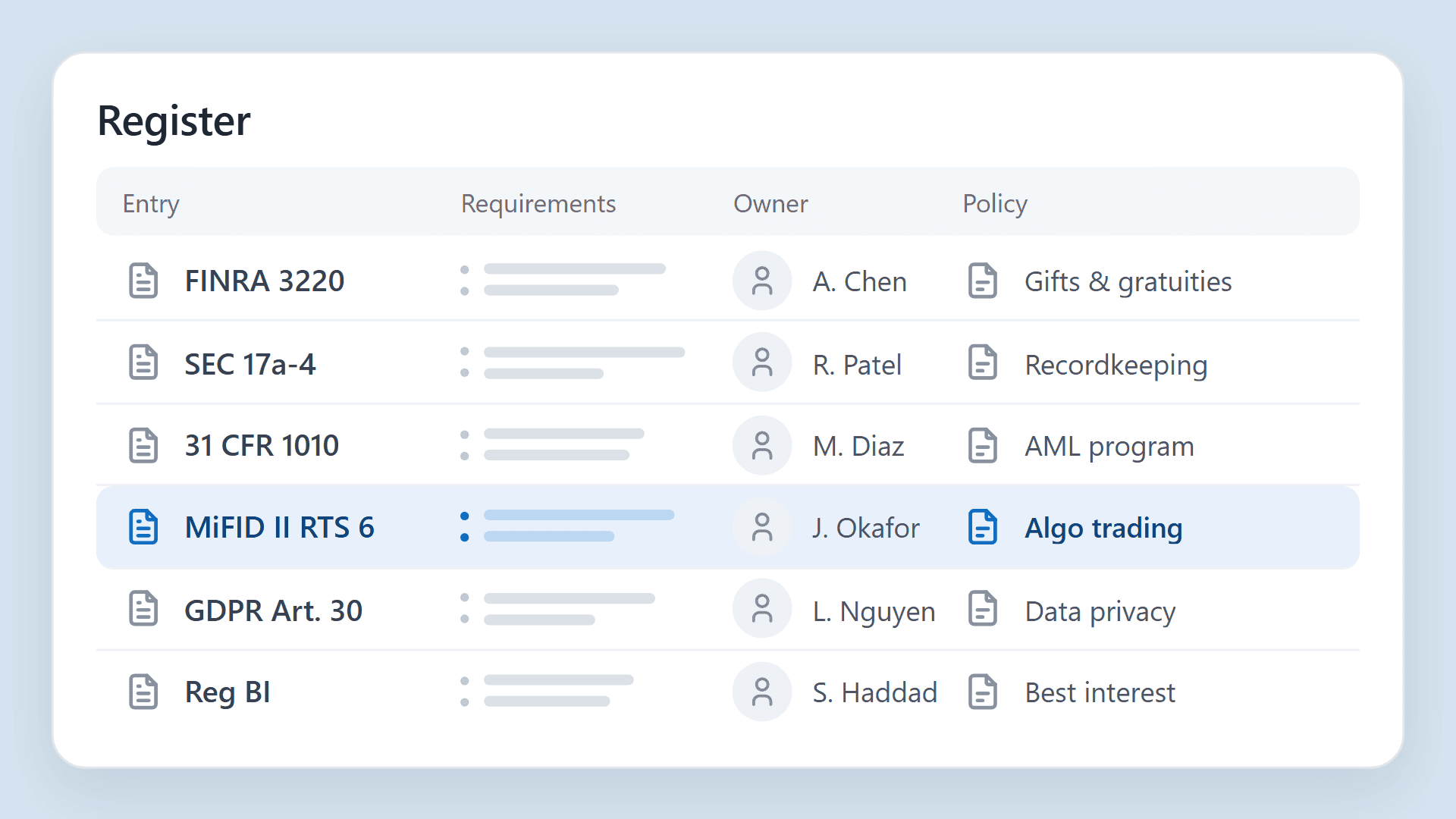
Almost every compliance team knows it should keep a register of laws, rules, and regulations. Most don't. The ones that do usually find it out of date and only loosely connected to the policies meant to address it. Part of the problem is just getting started: it's a big project, and people suspect it will go stale not long after it's finished.
This is a practical guide to building one in Responsiv that stays current, with the maintenance falling out of work your team is already doing rather than landing as a separate chore.
What an LRR register actually is
Strip away the jargon and a register is an inventory of every obligation that applies to your business, mapped to the things you do about each one. Three layers sit underneath it:
- Requirements — the specific requirements pulled out of laws, rules, and regulatory guidance. Not "FINRA Rule 3110" as a citation, but the discrete duties inside it.
- Policies and controls — what your organization does to meet each obligation.
- Owners — the named person accountable for each entry, responsible for keeping its policies and controls up to date.
The register ties those layers together. When it works, you can answer the question every examiner eventually asks — "show me the rule that requires this, and the control that satisfies it" — without a week of digging through documents to reconstruct the answer.
Why most registers go stale
It's worth being honest about the failure mode before fixing it. Registers die for three reasons, and they compound:
- They're disconnected from the source. The spreadsheet has no idea when the underlying rule changes, so it can't prompt anyone.
- Maintenance is distributed and manual. "Keep the register current" is everyone's job, which means it's no one's. There's no organizational ownership, best practices, or accountability.
- It's hard to act on. A static register is difficult to consume and turn into action, so when it isn't wired into the organization's policies and controls, keeping it current gets deprioritized.
Building it in Responsiv
1. Define your organization
It starts during onboarding, where you map out who you are: your business description, your business units, the licenses you hold, the products you offer, and the jurisdictions you operate in. This profile is what lets Responsiv reason about which rules actually reach you, rather than handing you a generic universe to wade through.
2. Upload your policies, procedures, and WSPs
Bring in the documents you already have — policies, procedures, and written supervisory procedures. These give Responsiv rich context about how your business actually operates: the controls you run, the language you use, and the way your obligations are already being met. The more the system understands about you, the sharper its suggestions get.
3. Define your core regulatory topics
Tell Responsiv the areas that matter to your business — supervision, AML, recordkeeping, marketing, and so on. This ensures the register has coverage on the obligations that are most critical to your business.
4. Let Responsiv suggest obligations
With your organization, documents, and topics in place, Responsiv suggests the obligations that apply — pulled from regulatory content across hundreds of corpora and broken into discrete, actionable requirements rather than whole rules. This is the heavy lifting that used to take years to complete.
5. Review them — on your own or with a partner
Suggestions are a starting point, not the final word. Your team reviews the obligations, confirms what applies, and adjusts the mapping to your policies and controls. If you'd rather not do it alone, you can work through the review with a Responsiv partner.
6. Run a gap analysis when you're ready
When it suits you, have the system run a gap analysis to surface obligations with no policy or control behind them — or simply let it run at your next policy review cycle. Either way, the gaps surface before an examiner finds them.
Keeping it from going stale
Here's where the platform earns its place. Because the register is anchored to live sources, it doesn't sit still:
- When a rule you've mapped changes, the affected obligations are flagged — and so is every policy and owner downstream of them.
- Reviews come to owners when there is a change instead of waiting for an annual panic.
- The audit trail captures every change, so you can show where you stand today and how you got there.
What good looks like
A healthy register is fairly boring to operate. Changes come in from the source, owners get prompted to review them, and gaps show up early enough to fix. There's no quarterly scramble to get exam-ready, because the register never drifted far from current in the first place.